Carmel Mountain Ranch Real Estate and Community Guide

Carmel Mountain Ranch is a compact, master-planned community in northeastern San Diego, immediately east of Interstate 15. Its location between Rancho Bernardo and Sabre Springs, with Poway at its eastern edge and Rancho Peñasquitos across the freeway, gives residents direct access to the I-15 employment corridor, substantial everyday shopping, and routes leading both inland and toward the coast.
The community does not have one traditional main street. Instead, it was planned as a connected mix of residential neighborhoods, business and commercial areas, parks, landscaped open space, and curving collector roads. Most homes were built during the community’s principal development years in the late 1980s and 1990s. Buyers will find detached houses, townhomes, and condominiums in a relatively small geographic area, often with mature landscaping and architectural details associated with that period.
The former Carmel Mountain Ranch Country Club is also part of the community’s present-day story. The golf course stopped operating in 2018, and portions of the former course were redesignated for new housing, parks, open space, and pedestrian and bicycle connections. That change makes location-specific investigation especially important for homes near former fairways or planned construction.
This guide explains how Carmel Mountain Ranch is organized, what its housing looks like, where residents shop and recreate, how transportation works, and which property details buyers and sellers should examine. Real estate conditions change, so current listings and recent comparable sales should be reviewed when you are ready to make a decision.
Where Is Carmel Mountain Ranch Located?
Carmel Mountain Ranch is within the City of San Diego, not the neighboring City of Poway. The City’s community plan describes an approximately 1,489-acre planning area east of I-15. Rancho Bernardo is directly north, Sabre Springs is south, Poway meets the community on the east, and Rancho Peñasquitos lies west of the freeway.
Several roads define daily movement:
- Interstate 15 is the principal north-south freeway and provides access toward Rancho Bernardo, Escondido, Kearny Mesa, Mission Valley, and central San Diego.
- Ted Williams Parkway/State Route 56 begins at the community’s southern side and travels west through Rancho Peñasquitos toward Carmel Valley and Interstate 5.
- Carmel Mountain Road is the main commercial spine, connecting shopping centers, residential streets, and freeway ramps.
- Rancho Carmel Drive runs through residential, recreation, and commercial portions of the community.
- Camino del Norte connects the northern and eastern portions of Carmel Mountain Ranch with Rancho Bernardo, 4S Ranch, and Poway-area routes.
- Paseo Lucido continues east from Carmel Mountain Road toward Poway.
This location can be useful for trips along the I-15 corridor and for westbound travel on SR-56, but proximity on a map does not guarantee a quick commute. The I-15/SR-56 interchange, Ted Williams Parkway, Carmel Mountain Road, and connecting arterials can become congested during peak periods. Anyone moving for a specific workplace should test the route at the actual days and times they expect to travel.
MCAS Miramar lies farther south along the I-15 corridor. Downtown San Diego, San Diego International Airport, the coast, and North County destinations are accessible by freeway, but travel times vary substantially with traffic. Carmel Mountain Ranch itself is inland, so beaches and major coastal attractions require a drive.
Community History and Development
The land is within the traditional territory of the Kumeyaay people, whose presence in the region reaches far back before modern development. In the twentieth century, planning documents referred to the area as Rancho Carmel and Carmel Mountain East.
The City approved the Rancho Carmel Community Plan in 1981. After a change in ownership and further environmental and market review, the 1984 Carmel Mountain Ranch Plan replaced it. The revised concept increased employment land and open space, reduced the planned number of homes, and organized commercial and public uses around a town-center concept. A golf course was approved in 1986.
Development proceeded through the late 1980s and 1990s. By 1999, the City’s plan reported that the anticipated residential, retail, office, industrial, institutional, and major road improvements had been constructed. This concentrated building period explains why many streets share coordinated architecture, landscaping, setbacks, walls, and association-maintained features.
The golf course operated until 2018. A 2021 community-plan amendment redesignated portions of the former course for residential use, including below-market-rate housing, while retaining other portions as open space and adding park, pedestrian, and bicycle provisions. Buyers should distinguish between the historical golf-course setting, land designated to remain open, and land approved or planned for development. Current maps, disclosures, City records, and construction information matter more than old listing descriptions.
Carmel Mountain Ranch Neighborhoods and Distinct Areas
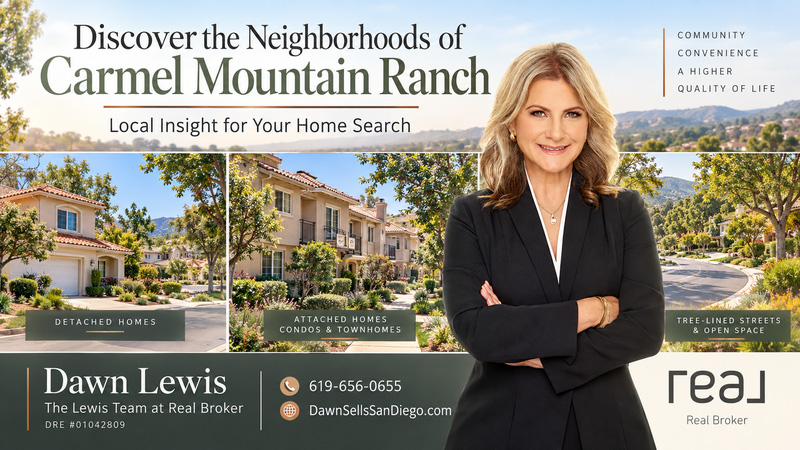
Carmel Mountain Ranch is smaller than many San Diego community-planning areas. It is better understood through its geographic pockets, development types, and individual associations than through a long list of informal neighborhood names. Formal subdivision or condominium names should be confirmed through title, HOA documents, and recorded maps.
The Northern Residential Pocket
North of Carmel Mountain Road and near Camino del Norte, housing is primarily arranged along curving streets and short cul-de-sacs. Detached homes predominate in several tracts, with attached-home enclaves mixed into the broader pattern. Many properties date from the community’s principal late-1980s-to-1990s buildout.
Elevation, slope, rear-yard orientation, and proximity to Camino del Norte can create meaningful differences between homes that otherwise share a floor plan. A residence with an open outlook may command different buyer interest from the same model facing another structure, a retaining slope, or an active road. Buyers should also verify whether landscaping, walls, roofs, and exterior features are individually or association maintained.
The Central Civic, Park, and Residential Area
The central portion around Highland Ranch Road, World Trade Drive, Rancho Carmel Drive, and nearby residential streets contains public recreation, a branch library, parks, and neighborhood housing. This is one of the community’s clearest examples of planned land-use proximity: homes, public facilities, paths, and commercial services are located within a relatively short radius.
Some residents can walk to particular facilities, but the experience varies by street because major roads, slopes, crossings, and parking-lot layouts interrupt the pedestrian network. A home close to a park may offer convenient access while also experiencing activity, field lighting, event traffic, or parking demand at certain times. Tour the immediate area during both active and quiet periods.
Housing Near the Former Golf Course and The Trails
Homes bordering the former Carmel Mountain Ranch golf course once were commonly marketed for fairway or golf-course views. Because the course closed and portions are now part of The Trails at Carmel Mountain Ranch redevelopment, those descriptions require updated context.
The approved project encompasses a mix of townhomes and apartments, including income-restricted homes, together with neighborhood parks, open space, and new walking and bicycling connections. Construction timing and conditions can change. A buyer considering a nearby home should review the most recent site plans and City records, identify which former holes are designated for development or open space, and investigate anticipated construction, access, grading, lighting, traffic, views, and long-term maintenance arrangements.
This is a highly localized issue. Two homes separated by only a few streets may face different portions of the former course or have no direct relationship to the redevelopment.
The Southern Edge Near Ted Williams Parkway
South of the main commercial core and close to Ted Williams Parkway, residential streets connect quickly to SR-56 and I-15. This can shorten the distance to freeway ramps, while also making roadway orientation and sound more important during a showing.
The terrain includes slopes and drainage features associated with Chicarita Creek and the community’s planned open-space system. Buyers should evaluate the actual parcel, retaining improvements, drainage, and brush or open-space adjacency rather than applying a community-wide assumption.
Attached-Home Communities
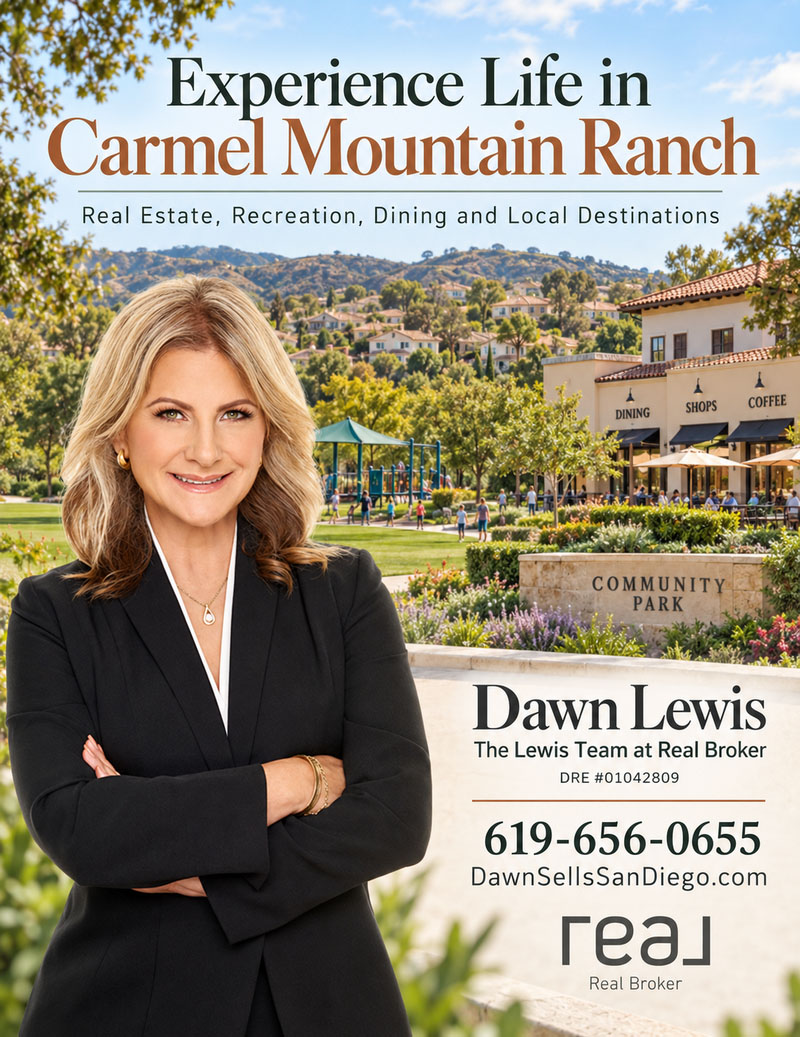
Attached housing appears in several enclaves rather than one single condominium district. Collage, around Tivoli Park Row, is a verified attached-home community with multilevel residences, garages or assigned parking configurations, patios or balconies on some plans, and shared recreation facilities. Il Palio, on Alta Carmel Court, is another verified condominium community with shared amenities and a different unit, parking, and maintenance structure.
Community names used in listings can overlap with nearby Sabre Springs or broader MLS area labels. Confirm the legal development name and City/community boundary instead of relying only on a portal’s neighborhood tag. For every attached property, compare the unit’s location within the complex, stairs, natural light, outdoor area, garage or carport rights, guest parking, and exposure to roads, pools, trash enclosures, and internal driveways.
Commercial and Employment Areas
The large commercial district near Carmel Mountain Road, Rancho Carmel Drive, and I-15 is not a residential neighborhood, but it strongly shapes daily life. Regional retail, groceries, restaurants, a cinema, home-improvement stores, personal services, and employment uses are clustered here. Office and employment properties also extend along portions of the I-15 side of the community.
Living close to this area can make errands short. It can also mean more traffic, delivery activity, parking-lot lighting, and commercial noise. The difference between “near shopping” and “backing to a commercial use” should be evaluated at the specific address.
What Locals Understand About Carmel Mountain Ranch
Carmel Mountain Ranch and Sabre Springs Are Not the Same Community
Real estate searches often combine Rancho Bernardo, Sabre Springs, and Carmel Mountain Ranch into a broad MLS area. This is useful for seeing inventory, but it can blur community boundaries. Sabre Springs lies south of Carmel Mountain Ranch, and its condominium developments and comparable-sale patterns should not automatically be substituted for those in Carmel Mountain Ranch.
The Commercial Core Is a Major Part of the Lifestyle
Carmel Mountain Ranch functions differently from a neighborhood built around a small village street. Daily routines frequently center on several large shopping centers near the freeway. It is possible to combine groceries, household shopping, dining, books, fitness, movies, and other errands in a compact commercial zone, but moving between centers may still be easier by car because of wide roads and expansive parking areas.
Inland Weather Is Noticeably Different From the Coast
The community is far enough inland to experience warmer summer afternoons and less persistent marine influence than coastal San Diego. Coastal cloud cover can reach inland on some mornings, but it often clears earlier. Shade, home orientation, window exposure, insulation, HVAC condition, and usable outdoor space can therefore matter during a property comparison.
Road and Construction Conditions Are Address-Specific
I-15, SR-56, Carmel Mountain Road, and Camino del Norte provide excellent regional connections, but properties oriented toward active roads may experience different sound and view conditions. Near the former golf course, redevelopment adds another layer of site-specific investigation. Visit at commute hours, evenings, and weekends if these conditions matter to you.
Mature Landscaping Comes With Maintenance Questions
Many neighborhoods now have mature trees, planted slopes, irrigation systems, walls, and fences that have aged along with the homes. Attractive landscaping can also raise questions about roots, drainage, irrigation leaks, slope maintenance, and whether an HOA or owner is responsible for particular areas.
Homes and Real Estate in Carmel Mountain Ranch
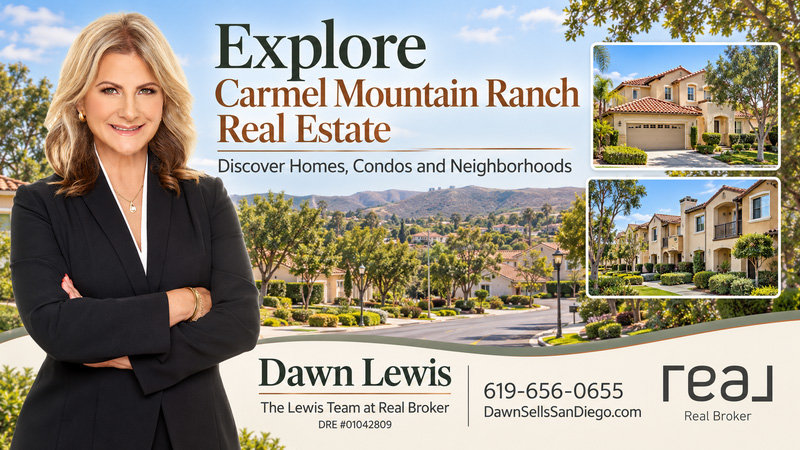
Carmel Mountain Ranch real estate offers three principal categories: detached houses, townhomes, and condominiums. Most existing homes reflect late-twentieth-century planned-community design. Stucco exteriors, tile or composition roofs, attached garages, vaulted ceilings, fireplaces, patios, balconies, and open living/dining arrangements are common, although features vary by tract and renovations.
Detached Homes
Detached homes range from comparatively compact tract residences to larger two-story floor plans. Lots are usually suburban rather than rural; usable yard area can differ significantly because of slope, setbacks, retaining walls, and the footprint of the home. Cul-de-sac placement, corner lots, views, street activity, and backyard orientation can all affect marketability.
Original systems may now be several decades old. Buyers should investigate roofs, heating and cooling equipment, windows, plumbing, electrical components, drainage, exterior stucco, balconies or decks, and prior remodeling. A remodeled kitchen does not establish the condition of less-visible systems.
Townhomes and Condominiums
Attached homes can offer lower-maintenance exterior living and access to shared facilities, but the ownership package matters as much as the interior. Some residences have attached garages; others use detached garages, carports, or assigned spaces. Guest-parking supply and rules can vary. Stairs, unit level, common walls, interior location, and proximity to amenities can affect convenience and value.
Planned Development and Association Costs
Some properties belong to a condominium association, planned development, master association, or more than one governing organization. Do not assume that every Carmel Mountain Ranch home has the same HOA obligations—or any HOA at all. Request the complete current package for the specific property.
Mello-Roos or other special tax obligations may apply to certain properties. The community plan documents historical use of community-facilities financing, but that does not establish the present charge, remaining term, or amount for an individual parcel. Review the current property-tax bill and obtain qualified guidance before relying on a listing summary.
Features That Influence Value
Two homes with similar living area and bedroom count can sell differently because of:
- Legal subdivision or condominium community
- Detached versus attached ownership
- Floor-plan usability and bedroom placement
- Renovation quality and permit history
- Lot size, slope, privacy, and usable outdoor area
- View direction and possible future changes to that view
- Road, commercial, recreation, or construction exposure
- Garage, driveway, assigned parking, and guest parking
- HOA dues, reserves, amenities, rules, and assessments
- Roof, HVAC, plumbing, windows, and other major systems
- Solar ownership or financing terms
- Proximity to parks, shopping, and freeway access
A neighborhood-level comparative market analysis should use genuinely comparable recent sales and adjust for these differences rather than relying on a ZIP-code average or automated estimate.

Condominium and Townhome Considerations
Before purchasing an attached home, review both the residence and the association. Important documents may include the declaration and rules, budget, reserve study, financial statements, insurance information, meeting minutes, notices, assessment history, litigation disclosures, and pending project information.
Confirm:
- What the owner maintains and what the association maintains
- Current dues and any approved or discussed increases
- Existing or anticipated special assessments
- Master-insurance coverage, deductibles, and owner-policy requirements
- Roof, balcony, window, plumbing, and exterior responsibility
- Parking and storage rights shown in governing documents or title
- Guest-parking rules and enforcement
- Pet, rental, renovation, and use restrictions
- Move-in procedures and contractor requirements
- Whether the property and association meet the buyer’s lender requirements
Shared pools, spas, exercise facilities, courts, landscaping, and private streets can add utility, but they also create long-term maintenance obligations. An attractive amenity package should be evaluated alongside reserve funding and upcoming capital work.
Parks, Trails, and Outdoor Recreation
Carmel Mountain Ranch/Sabre Springs Recreation Center
The City recreation center at 10152 Rancho Carmel Drive is a central public facility serving both communities. The City lists an indoor gymnasium used for basketball, volleyball, and pickleball; outdoor basketball and pickleball courts; ball fields; a multipurpose room; playgrounds; picnic areas; and an accessible restroom. Classes, open-play schedules, and hours can change, so check the City’s current program information before visiting.
The center opened in 1997 after community planning focused on making effective use of a limited site. Its location near residential streets and the freeway illustrates the community’s compact planning pattern.
Carmel Mountain Ranch Community Park and Highland Ranch Park Area
The public park system includes active recreation, turf, picnic, playground, and pathway areas within the community. Carmel Mountain Ranch Community Park is associated with the recreation center and Chicarita Creek area, while the Highland Ranch Road vicinity includes neighborhood park and civic facilities. Confirm field reservations, lighting schedules, event rules, and facility availability through City Parks and Recreation.
Community Trails and Open Space
The adopted plan links parks and open spaces with pedestrian and bicycle paths where topography allows. Some routes function as short neighborhood connections rather than destination hikes. Open-space edges can provide visual relief and walking access, but residents should respect posted boundaries and determine whether a path is public, association maintained, or part of a construction area.
The Trails redevelopment is planned to add parks and multiple miles of pedestrian and bicycle connections within the former golf-course property. Treat proposed or under-construction features according to their current status; do not assume every planned route is open.
Nearby Regional Recreation
Larger outdoor destinations require a short drive. Los Peñasquitos Canyon Preserve, west and southwest of the community, offers a much broader trail environment than Carmel Mountain Ranch’s neighborhood paths. Black Mountain Open Space Park is also nearby to the west, with steeper terrain and regional views. To the east, Lake Poway provides trails, picnic areas, and reservoir-based recreation under City of Poway rules. These destinations are near Carmel Mountain Ranch, not within it. Check official access, parking, weather, trail, and permit information before visiting.
Restaurants, Coffee, and Local Food
Dining is concentrated in and around the major retail centers rather than dispersed along residential streets. The current Carmel Mountain Plaza directory includes:
- Broken Yolk Café, a San Diego-founded breakfast and lunch restaurant
- Dumpling Bar, focused on dumplings and related casual dishes
- Fish District, serving seafood in a counter-service format
- In-N-Out Burger, the regional quick-service chain
The recreation center’s current community-partner list also identifies Oggi’s Pizza of Carmel Mountain Ranch and Cafe Luna, providing additional locally recognizable options. Because restaurants and hours can change, readers should confirm current operations directly before making plans.
For a wider range of independent dining, residents commonly travel to nearby Rancho Bernardo, Poway, Rancho Peñasquitos, and 4S Ranch. This is one of the practical distinctions of Carmel Mountain Ranch: everyday dining is abundant, but much of it is located in shopping centers and includes familiar regional or national concepts. A broader restaurant evening may involve a short drive into a neighboring district.
Shopping and Everyday Conveniences
Shopping access is one of Carmel Mountain Ranch’s defining objective features.
Carmel Mountain Plaza
Carmel Mountain Plaza is a regional shopping center near I-15. Its current tenant information includes Nordstrom Rack, Dick’s Sporting Goods, Barnes & Noble, Marshalls, Michaels, Ross, Sprouts, At Home, Angelika Film Center, restaurants, and specialty services. The exact tenant mix can change, but the center’s scale makes it more than a neighborhood retail strip.
Groceries and Household Errands
Trader Joe’s operates a Carmel Mountain Ranch store at 11955 Carmel Mountain Road. Costco operates a warehouse on Carmel Mountain Road, with associated services listed on Costco’s location page. Ralphs, Home Depot, and other retail and service businesses are also represented in the commercial district and on current local real estate pages.
The key practical point is concentration: multiple shopping centers sit close together, although wide streets and parking lots mean that many shoppers drive between stops. Properties east of the core or near the Poway boundary remain only a short road trip from these services, but they do not necessarily offer door-to-door pedestrian access.
Things to Do and Community Experiences
Daily recreation tends to center on parks, association amenities, neighborhood paths, fitness activities, dining, shopping, and movies. Angelika Film Center at Carmel Mountain Plaza provides an in-community cinema option. The City recreation center hosts changing programs and has listed seasonal activities such as Movies in the Park and a fall carnival; dates and formats should be verified on the current City calendar.
Nearby options expand considerably:
- Hike or bike at Los Peñasquitos Canyon Preserve or Black Mountain Open Space Park.
- Visit Lake Poway for outdoor recreation subject to current City rules.
- Explore restaurants and community events in Poway, Rancho Bernardo, and 4S Ranch.
- Use SR-56 for trips toward Carmel Valley, Torrey Pines-area destinations, and the coast.
- Travel north on I-15 toward Escondido attractions or south toward central San Diego.
These are regional day-trip relationships, not claims that the attractions are inside Carmel Mountain Ranch.
Getting Around Carmel Mountain Ranch
Driving is the most flexible way to reach homes, shopping centers, workplaces, and regional destinations. I-15 provides north-south access, while SR-56 is the principal westbound connection toward I-5. Camino del Norte and Ted Williams Parkway carry substantial cross-community traffic, and Carmel Mountain Road serves both local and destination retail trips.
MTS Route 20 serves stops along Carmel Mountain Road and Rancho Carmel Drive and connects with Rancho Bernardo Transit Station and destinations farther south. The City identifies Route 20 as serving the Carmel Mountain Ranch/Sabre Springs Recreation Center. At Rancho Bernardo Transit Station, riders can connect with Rapid service, including Route 235; parking availability, schedules, and service patterns should be checked through MTS before relying on a commute plan.
Walking works best for short trips within individual residential pockets or between a home and a nearby park or commercial destination. Community trails and sidewalks provide connections, but freeway ramps, broad arterials, slopes, and large shopping-center blocks prevent the entire community from functioning as one continuously walkable district.
Cyclists should review current City bikeway maps and ride the route personally. Some planned paths are associated with ongoing redevelopment and may not yet be open. San Diego International Airport is reached by freeway and surface streets; trip length is traffic-dependent.
Weather, Topography, and Microclimate
Carmel Mountain Ranch has an inland San Diego climate. Summer afternoons are generally warmer than at the coast, while evenings and winter mornings can be cooler. Marine-layer clouds sometimes move inland, but coastal overcast is usually less persistent here. Heat waves can produce conditions well above seasonal averages.
The community occupies rolling terrain with slopes, creek areas, and higher points that can produce localized view and wind differences. Home orientation affects afternoon sun, natural light, patio comfort, and cooling demand. A west-facing upper-floor room may feel very different from a shaded ground-level unit, even in the same development.
Topography also affects real estate. Buyers should inspect drainage paths, retaining walls, planted slopes, and irrigation, especially where a property borders open space or sits above or below another lot. Views should be evaluated together with applicable development plans; no existing outlook should be assumed permanent without appropriate investigation.

Practical Home-Buying Considerations
Before purchasing a Carmel Mountain Ranch home, investigate the specific property rather than relying on broad community descriptions. Depending on the address, relevant questions may include:
- Is there an HOA, sub-association, or master association?
- What are the current dues, reserves, insurance, rules, and assessment history?
- Does the current tax bill include Mello-Roos or another special assessment?
- What development, open-space, or construction plans affect nearby former golf-course land?
- How do traffic and road noise change by time of day?
- Are parking spaces, garages, storage areas, and guest rights properly documented?
- Who maintains slopes, walls, fences, roofs, balconies, windows, and drainage features?
- Are additions, remodels, patio enclosures, or garage changes permitted?
- What is the age and condition of the roof, HVAC, plumbing, electrical system, windows, and water heater?
- Is solar owned, financed, leased, or subject to a power-purchase agreement?
- What do title documents disclose about easements, boundaries, and restrictions?
- Does open-space or brush adjacency affect maintenance or insurance options?
- Are there active construction, commercial-lighting, or delivery impacts near the property?
- Do local rules allow the buyer’s intended rental, pet, parking, renovation, or accessory-unit use?
Not every issue applies to every home. Buyers should use the inspection and disclosure period to consult qualified inspectors, lenders, insurance professionals, title and escrow personnel, HOA specialists, attorneys, tax advisors, or City staff as appropriate. This guide is informational and does not replace property-specific professional advice.

Pricing a Carmel Mountain Ranch property requires more precision than applying an average for ZIP code 92128. The strongest comparables generally share the same property type, legal development, floor-plan scale, association structure, and immediate location.
For detached homes, lot usability, orientation, road exposure, view, remodeling, system condition, and the relationship to former golf-course land can influence buyer response. For condos and townhomes, buyers also compare dues, amenities, reserve strength, insurance, assessments, garage or parking configuration, unit level, common-wall placement, and location inside the complex.
Preparation should be based on likely return, not a generic remodeling checklist. Cleaning, landscape care, paint, lighting, minor repairs, and thoughtful staging often improve presentation. Major work should be evaluated in relation to competing homes, cost, timing, and buyer expectations.
Professional photography and accurate copy should show how the home functions and explain the Carmel Mountain Ranch location. Effective marketing can connect the property to nearby shopping, parks, recreation, and transportation without overstating walkability, views, future land use, or commute times.
Dawn Lewis and The Lewis Team can prepare a customized comparative market analysis, identify the homes that genuinely compete with yours, recommend a launch strategy, coordinate professional presentation, expose the property online, evaluate offer terms, negotiate through inspections and appraisal, and manage the transaction through closing.
Buying a Home with Dawn Lewis and The Lewis Team
Dawn Lewis brings more than 35 years of San Diego real estate experience to buyers considering Carmel Mountain Ranch. Her role is not simply to open doors. It is to help a buyer compare the correct communities, recognize property-level tradeoffs, evaluate value, and move through the transaction with a clear plan.
Dawn and The Lewis Team can help you:
- Compare Carmel Mountain Ranch with Rancho Bernardo, Sabre Springs, Rancho Peñasquitos, Poway, 4S Ranch, and other areas using your stated priorities
- Build a customized search for detached homes, condos, or townhomes
- Distinguish legal communities and associations from broad MLS labels
- Analyze comparable sales and active competition
- Evaluate HOA, parking, condition, road, slope, open-space, and redevelopment considerations
- Prepare and negotiate an offer suited to the property and market
- Coordinate inspections, disclosures, title, HOA review, insurance investigation, appraisal, lending, and escrow
- Manage a purchase remotely for buyers moving from outside San Diego
- Coordinate the sale of an existing property when the purchase depends on it
Dawn Lewis
The Lewis Team at Real Broker
California DRE #01042809
619-656-0655
https://www.dawnsellssandiego.com
Frequently Asked Questions About Carmel Mountain Ranch
Where is Carmel Mountain Ranch located?
Carmel Mountain Ranch is in the northeastern part of the City of San Diego, east of I-15. Rancho Bernardo is to the north, Sabre Springs to the south, Poway to the east, and Rancho Peñasquitos west of I-15.
What types of homes are available in Carmel Mountain Ranch?
Buyers can find detached houses, townhomes, and condominiums, with much of the housing built during the late 1980s and 1990s. Floor plans, lot sizes, parking, amenities, and association structures vary by development.
What are the main areas within Carmel Mountain Ranch?
Useful distinctions include the northern residential pocket near Camino del Norte, central neighborhoods near civic and recreation facilities, homes near the former golf-course land and The Trails redevelopment, the southern edge near Ted Williams Parkway, and attached-home communities such as Collage and Il Palio.
Are Carmel Mountain Ranch and Sabre Springs the same community?
No. They are adjacent but separate communities. Real estate websites and MLS searches sometimes group them together, so buyers should verify the actual community, legal development, HOA, and appropriate comparable sales.
Are there condominiums and townhomes in Carmel Mountain Ranch?
Yes. Attached homes are located in several developments. Buyers should compare unit layout, stairs, common walls, garage or assigned parking, guest parking, amenities, HOA finances, insurance, rules, and maintenance responsibilities.
Does Carmel Mountain Ranch have HOA or Mello-Roos costs?
Some properties have HOA obligations, and property-specific special taxes or assessments may apply. There is no single answer for the entire community. Review the current tax bill, title information, and complete association documents for the individual property.
What happened to the Carmel Mountain Ranch golf course?
The golf course ceased operations in 2018. A 2021 City plan amendment redesignated portions of the former course for housing, parks, open space, and new pedestrian and bicycle connections. Buyers near the site should review current plans and construction status.
What parks and outdoor activities are available?
The Carmel Mountain Ranch/Sabre Springs Recreation Center offers indoor and outdoor recreation facilities, fields, playgrounds, picnic areas, and changing programs. Neighborhood paths and open space provide local connections. Los Peñasquitos Canyon Preserve, Black Mountain Open Space Park, and Lake Poway are nearby regional destinations, not within the community.
What shopping is available in Carmel Mountain Ranch?
Carmel Mountain Plaza and surrounding centers provide regional and everyday shopping. Current options include major apparel and sporting-goods retailers, bookstores, craft and home stores, grocery stores, a cinema, restaurants, Costco, Trader Joe’s, and household services.
What is the restaurant scene like?
Most restaurants are concentrated in shopping centers and include casual, regional, and national options. Current Carmel Mountain Plaza listings include Broken Yolk Café, Dumpling Bar, Fish District, and In-N-Out. Nearby communities expand the independent dining choices.
How is access to other parts of San Diego County?
I-15 provides north-south access, and SR-56 travels west toward I-5 and coastal North County. Actual travel times depend on traffic, incidents, and time of day. Buyers should test important trips during their expected commute hours.
Is public transit available?
MTS Route 20 serves Carmel Mountain Road and Rancho Carmel Drive and connects toward Rancho Bernardo Transit Station and destinations to the south. Rapid connections are available at Rancho Bernardo Transit Station. Check current MTS schedules before planning a regular trip.
What should someone know before moving to Carmel Mountain Ranch?
Expect a planned, inland community with substantial shopping, curving residential streets, attached and detached housing, and strong freeway access. Also investigate peak traffic, inland summer heat, HOA obligations, parking, aging systems, slope and drainage, and the status of nearby former golf-course land.
How can Dawn Lewis help a Carmel Mountain Ranch buyer or seller?
Dawn can build a customized home search, compare distinct areas and developments, analyze comparable sales, guide property and HOA due diligence, negotiate an offer, coordinate the transaction, or create a property-specific pricing and marketing strategy for a seller.
Ready to Explore Carmel Mountain Ranch Real Estate?
If you are considering moving to Carmel Mountain Ranch, Dawn Lewis can answer questions, help you compare developments and properties, arrange private home tours, and create a customized home search. If you own a home in the community, Dawn and The Lewis Team can prepare a property-specific value analysis and selling strategy.
Dawn Lewis
The Lewis Team at Real Broker
California DRE #01042809
Call or text: 619-656-0655
https://www.dawnsellssandiego.com


