What Will 2026 Bring for the San Diego Real Estate Market
Predictions for Detached homes + “attached” single-family alternatives like townhomes/condos
San Diego’s housing market heads into 2026 with a familiar mix of forces: high prices, limited supply, and buyers who are extremely payment-sensitive. The big difference versus the last couple of years is that borrowing costs are no longer climbing—and that alone can change behavior, even if rates don’t “crash” lower.
Below is a data-based outlook for 2026 that separates single-family detached from single-family attached (townhomes/condos), because the two segments often react differently to rates, affordability, and inventory.
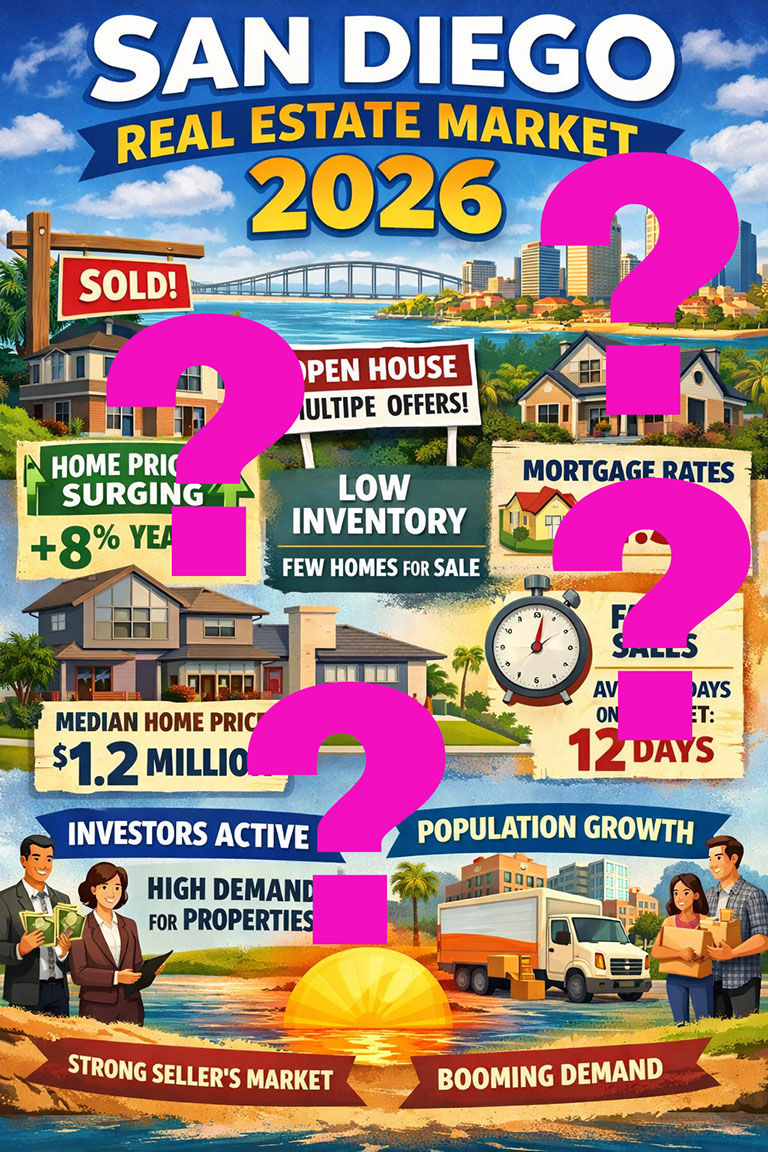
Where San Diego is starting 2026: the market’s “baseline”
Before predicting 2026, you have to anchor to the latest measurable reality.
San Diego County (MLS-based snapshot)
From the Greater San Diego Association of REALTORS® market report (data current as of early January 2026), December 2025 closed with:
- Detached median sales price: $1,050,000 (up 5.0% YoY)
- Attached median sales price: $680,000 (up 3.0% YoY)
- Inventory (end of month): Detached 1,027 (down 54.7% YoY), Attached 849 (down 44.5% YoY)
- Days on market (until sale): Detached 44 (+10% YoY) and Attached 38 (+24.4% YoY)
- Months of supply (December): about 1.3 months (very tight)
What that tells us: even with longer market times, San Diego is still operating in a low-supply environment—more “tight and selective” than “loose and falling.”
The 5 drivers most likely to shape 2026
1) Mortgage rates: lower helps, but “back to 3%” isn’t the base case
As of January 8, 2026, Freddie Mac’s weekly survey put the average 30-year fixed at about 6.16%.
Major forecasts generally expect rates to hover around the low-6% range rather than plunge. For example, C.A.R.’s statewide forecast projects an average 30-year fixed around 6.0% in 2026.
2026 implication:
- If rates drift down even modestly (say mid-6s to low-6s), payment-qualified buyers return.
- If rates stall or rise, attached product usually feels it first because the buyer pool is more rate-sensitive.
2) Inventory: the entire forecast hinges on “how many sellers decide to move”
San Diego remains constrained by a long-running supply issue: owners with low locked-in rates, limited move-up options, and high replacement costs. The MLS report shows inventory was extremely low at year end (December 2025) in both detached and attached.
2026 implication:
- A meaningful price decline is hard to sustain without a supply surge or a job shock.
- A modest rate decline can increase demand faster than supply, pushing pricing back into mild appreciation.
3) Sales volume: the “comeback” story is more believable than the “crash” story
Nationally, NAR’s chief economist has projected a notable sales rebound in 2026 (double-digit growth in transactions) and continued price gains nationally. San Diego won’t mirror the nation perfectly—but if transaction volume rises, it usually improves price support in submarkets with chronically low supply (many parts of coastal and central San Diego).
4) Affordability: detached and attached will diverge
- Detached is the “equity-driven” market in San Diego: move-up buyers, high-income professionals, multi-generational wealth, and cash/equity positions.
- Attached is the “monthly payment” market: first-time buyers, downsizers, and affordability-focused households.
When affordability improves even slightly (rate dip, income growth, price stabilization), attached demand typically responds faster—but attached also faces HOA sensitivity and investor math (rent vs payment spreads).
5) New construction and resale competition
San Diego’s resale market dominates, but new builds still matter at the margins because builders can buy down rates and offer incentives. When resale supply is thin, builders become the “pressure valve” for demand—especially for attached products and newer master-planned pockets.
2026 price outlook: the base case and realistic ranges
Base case for 2026 (most likely)
- Detached: flat-to-moderate appreciation (think low single digits)
- Attached: modest appreciation, with more volatility neighborhood-to-neighborhood
Why? Because the market is starting from tight supply (~1–1.5 months) and prices that already proved they can hold even as days-on-market increased.
A practical “range” (not a promise)
- Detached: roughly 0% to +5%
- Attached: roughly -2% to +6%
Attached has a wider range because it is more sensitive to:
- mortgage rate direction,
- HOA dues and insurance costs,
- and buyer substitution (renting longer vs buying).
How this aligns with broader California expectations
C.A.R.’s statewide 2026 forecast calls for mild price growth and a slight improvement in sales.
San Diego often behaves as a “premium coastal” market inside that statewide trend—meaning it can outperform on price stability when supply remains constrained.
Detached vs. Attached: what I expect to be different in 2026
Single-family detached (SFD): “tight, picky, but supported”
What drives detached in 2026
- Move-up sellers are still constrained (replacement cost shock).
- Many buyers are equity-rich from prior homes.
- School-adjacent, coastal-adjacent, and commute-friendly pockets remain supply-starved.
What to watch
- If rates fall even a little, well-priced detached homes will still get multiple-offer activity—especially under key psychological price points.
Single-family attached (townhomes/condos): “rate-sensitive, value-driven”
What drives attached in 2026
- If rates stabilize or dip, first-time buyers re-enter.
- Downsizers who want lower maintenance are active, but they compare HOA + insurance + taxes carefully.
- Investors are selective: the rent-to-payment gap matters.
What to watch
- Buildings/communities with rising HOA, deferred maintenance, or insurance issues can underperform even if the broader market improves.
- New construction incentives can pull demand away from resale attached inventory.
The most likely 2026 market “shape” in San Diego
Here’s the pattern I expect most consumers to feel:
- Early 2026: more normal seasonality (buyers test the waters, sellers cautious)
- Spring 2026: best chance for competition to return if rates cooperate
- Late 2026: market becomes more segmented—some neighborhoods feel hot, others feel flat
This is consistent with a market that is no longer “pandemic chaotic,” but still not “fully balanced.”
Risks that could change the forecast
No forecast is complete without the “what would break it” list:
- Rates re-accelerate upward (inflation surprise, bond yields rise): attached softens first, then detached.
- Labor market shock (significant job losses): forced selling rises, inventory loosens.
- Policy or lending changes that materially alter buyer qualification.
- Insurance/HOA cost spikes (especially for attached): affordability gets worse even if rates drop.
What this means for buyers and sellers in 2026
If you’re buying in 2026
- Buy the payment, not the headline. If rates dip, competition returns quickly in San Diego.
- Attached buyers: scrutinize HOA budgets/reserves and insurance realities—those costs are “forever,” not just year one.
- Detached buyers: focus on micro-location, lot utility, and functional floorplans (those hold value best in flatter markets).
If you’re selling in 2026
- Pricing strategy matters more than 2021–2022. “DOM” Days on Market is higher than the frenzied years, so the market punishes “hope pricing.”
- The homes that win are the ones that feel turn-key, clean, and correctly priced—especially in the attached segment where buyers comparison-shop harder.
Bottom line prediction for 2026 (San Diego single-family)
San Diego enters 2026 with tight supply and prices that have been resilient, even as marketing times rose.
My expectation is a mildly improving market, led more by increased transactions (as rates cooperate) than by runaway price growth.
Interested in buying or selling your home or condo in San Diego?
Contact The Lewis Team, we would love to help! 619-981-3917